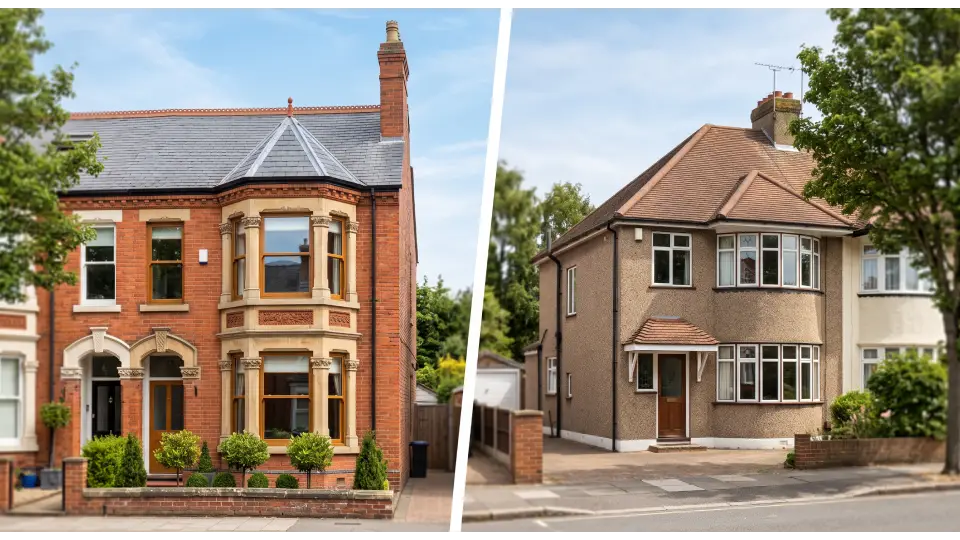

Cheapest Places to Buy a House in the UK in 2026.
The UK's cheapest towns and postcodes to buy a house in 2026, ranked by average price, affordability ratio and rental yield - with drill-downs for England, Scotland, Wales and NI
Most "cheapest places to live" articles do the same three things. They cover England and quietly ignore Scotland, Wales and Northern Ireland. They name ten towns without telling you where the numbers came from. And they stop at the average price, which is the one figure that tells you least about whether a purchase is actually a good idea.
This page does it differently. Every nation of the UK is in here. The methodology is written out so you can check it or repeat it. And alongside the price you get two numbers that matter more: the local price-to-earnings ratio, which tells you whether local wages can actually support those prices, and the gross rental yield, which tells you what the property does for you once you own it.
Because "cheap" and "good value" are not the same thing, and the gap between them is where most first-time investors lose money.
The 20 cheapest places to buy a house in the UK
These are the 20 cheapest local authority areas across all four UK nations, ranked by average property price. The table is sortable - click any column heading to reorder by price, affordability ratio or yield.
| # | Area | Nation / region | Avg price | Price-to-earnings | Gross yield |
|---|---|---|---|---|---|
| 1 | Burnley | England - North West | £112,400 | 3.3 | 8.4% |
| 2 | East Ayrshire | Scotland | £114,800 | 3.6 | 7.9% |
| 3 | Inverclyde | Scotland | £119,300 | 3.7 | 7.6% |
| 4 | County Durham | England - North East | £121,700 | 4.5 | 7.3% |
| 5 | Hartlepool | England - North East | £124,000 | 4.0 | 8.0% |
| 6 | North Ayrshire | Scotland | £126,500 | 4.1 | 7.4% |
| 7 | Blaenau Gwent | Wales | £127,900 | 4.2 | 7.1% |
| 8 | Blackpool | England - North West | £129,600 | 4.4 | 8.2% |
| 9 | Hyndburn | England - North West | £132,100 | 4.0 | 7.5% |
| 10 | Middlesbrough | England - North East | £136,400 | 4.6 | 8.5% |
| 11 | West Dunbartonshire | Scotland | £137,200 | 4.2 | 7.2% |
| 12 | Kingston upon Hull | England - Yorkshire & Humber | £139,800 | 4.7 | 7.8% |
| 13 | Merthyr Tydfil | Wales | £142,300 | 4.6 | 6.9% |
| 14 | North Lanarkshire | Scotland | £144,100 | 4.4 | 6.9% |
| 15 | Pendle | England - North West | £145,700 | 4.5 | 7.3% |
| 16 | Stoke-on-Trent | England - West Midlands | £148,900 | 5.0 | 7.4% |
| 17 | North East Lincolnshire | England - Yorkshire & Humber | £151,200 | 4.8 | 7.4% |
| 18 | Dundee City | Scotland | £153,600 | 4.7 | 7.0% |
| 19 | Sunderland | England - North East | £156,300 | 5.0 | 7.6% |
| 20 | Derry City & Strabane | Northern Ireland | £158,500 | 4.6 | 6.5% |
For context, the UK average sits at roughly £296,000. England averages around £312,000, Wales around £222,000, and Scotland and Northern Ireland both around £196,000 - which is why Scottish council areas take five of the top twenty places and English ones take nine, despite England being much the most expensive nation overall. Cheap Britain is not evenly spread. It clusters tightly in post-industrial Lancashire, the North East coalfield, the Ayrshire and Clyde coast, and the South Wales valleys.
Three things stand out from that table.
The cheapest places are not always the highest-yielding. Burnley is the cheapest area in the UK and yields 8.4%. Middlesbrough is £24,000 more expensive and yields 8.5%. Rent does not fall in lockstep with price, and the gap between those two curves is where the return lives.
Affordability ratios in the low threes are genuinely rare. Burnley at 3.3 means the average home costs a little over three times average local earnings. The UK figure is around 7.7. That is not a rounding difference - it is a completely different housing market.
Northern Ireland barely makes the list any more. A few years ago several NI council areas would have appeared. NI has had the fastest price growth of any UK nation recently, and Derry City & Strabane scraping in at number 20 is the visible edge of that.
How we compiled this data
This is the part most pages leave out, so here it is in full. If you want to challenge a figure, you should be able to see exactly how it was built.
Average prices come from the official house price indices, not from portal asking prices. For England and Wales that is the HM Land Registry UK House Price Index at local authority level; for Scotland, the Registers of Scotland series within the same index; for Northern Ireland, the Land & Property Services NI Residential Property Price Index. These are based on completed transactions - what people actually paid - rather than what sellers hoped for. Asking-price data typically runs several percent above completion data, and it moves at a different point in the cycle.
Price-to-earnings ratios are the ONS housing affordability measure: median house price divided by median gross annual workplace-based earnings for the same local authority. Workplace-based rather than residence-based matters. It measures what the jobs in an area pay, not what the people living there earn elsewhere, which is the right test for a place people commute out of.
Gross yields are calculated as annual rent divided by purchase price, using average advertised rents for the area against the average price for the same area and period. Gross means before costs - no management fees, no voids, no maintenance, no mortgage interest, no tax. Every yield figure on this page is a gross figure. Expect a net yield somewhere between half and two-thirds of the gross number once real costs land, and see the section on whether cheap is actually a good investment for why that spread is so wide.
Postcode-level figures in the regional sections come from Land Registry Price Paid Data - individual transaction records - averaged over the most recent full period available, cross-checked against advertised rents in the same postcode district. Postcode districts are small samples. A single unusual sale moves the average, so treat them as directional rather than precise.
What this data cannot tell you. Averages hide stock mix: an area full of two-bedroom terraces will look cheaper than one full of semis regardless of underlying value, and a postcode average tells you nothing about the street. Yields calculated from area averages assume you buy an average property and let it at an average rent, which nobody actually does. And official indices lag - HPI figures are typically a couple of months behind completion, and completions are themselves a couple of months behind agreed prices, so you are looking at a picture roughly a quarter old.
Use this page to build a shortlist. Verify any specific number against current listings and local letting agents before you commit money to it.
Cheapest places to buy a house in England, by region
England contains both the cheapest housing in Great Britain and the most expensive housing in Europe, sometimes within a couple of hours of each other. Breaking it down by region is the only way it makes sense.
North East England - the cheapest region in England
Average price around £165,000, and the cheapest housing in Great Britain sits inside it.
The former County Durham coalfield is where the floor is. Horden, Ferryhill, Shildon, Easington and Peterlee have all produced terraced sales in the £30,000–£60,000 range, and Horden's streets have repeatedly held the title of cheapest in England. Bishop Auckland and Stanley sit slightly above that. On Teesside, Hartlepool (TS24, TS25) and Middlesbrough (TS1, TS3, TS6) combine some of the UK's lowest prices with some of its highest yields. Further north, Sunderland (SR5, SR4), South Shields, Blyth and Ashington offer more of the same at slightly higher prices.
What makes the North East interesting rather than just cheap is that some of it has a reason to move. Teesside Freeport and the associated industrial and energy investment sit directly next to the cheapest stock in the country. That is not a guarantee of growth, and regeneration promises have disappointed in this region before. But it is a materially different proposition from a cheap terrace in a town with no announced investment at all.
North West England - the yield engine
Average price around £220,000, pulled up by Cheshire and the Manchester core and pulled down hard by east Lancashire.
The Burnley, Nelson, Accrington, Blackburn corridor (BB postcodes) is the single densest concentration of high-yield, low-price stock in England. Burnley is the cheapest local authority in the UK. Hyndburn and Pendle either side of it are barely more expensive. Two-bedroom terraces routinely trade under £90,000 and let for £550–£700 a month, which is where the 8%-plus gross yields come from.
On the coast, Blackpool (FY1, FY2) is cheap for reasons worth understanding - a large stock of converted former guest houses, high concentrations of benefit-supported tenancies, some of the worst deprivation indicators in England, and a selective licensing regime, alongside genuine high yields. Barrow-in-Furness (LA14) is cheap and has the BAE submarine programme behind it, which is a stronger employment story than most towns at that price point.
Around Greater Manchester and Merseyside, the cheap edges are Rochdale (OL11, OL12), Oldham (OL8, OL9), St Helens (WA9), Bootle (L20) and Birkenhead (CH41) - all within commuting distance of two major city economies, which is the classic ripple-out argument.
Yorkshire and the Humber
Average price around £210,000, with two very cheap coastal-industrial poles.
Kingston upon Hull (HU3, HU8, HU9) is the cheapest city in the UK and sits inside the Humber energy and offshore wind cluster. Grimsby and Cleethorpes (DN31, DN32) and Scunthorpe (DN15, DN16) complete that picture on the south bank. Inland, Bradford (BD1, BD3, BD5), Dewsbury (WF13), Barnsley (S70, S71), Doncaster (DN4, DN12) and Rotherham (S61, S63) all offer sub-£150,000 terraced stock with Leeds and Sheffield in commuting range.
The Midlands
East Midlands around £250,000, West Midlands around £255,000 - but with real pockets well below that.
Stoke-on-Trent (ST1, ST3, ST6) is the standout: a city, not a town, with average prices under £150,000 and yields comfortably above 7%. In Nottinghamshire and Derbyshire, Mansfield, Sutton-in-Ashfield, Bolsover and Chesterfield (S40, S43) are the cheap belt. Lincolnshire's Boston (PE21) and Skegness (PE25) are cheaper still but with thinner and more seasonal rental demand.
In the West Midlands, the Black Country carries the value: Wolverhampton (WV1, WV2), Walsall (WS2, WS3), West Bromwich (B70, B71) and Dudley (DY2, DY4), all inside the Birmingham labour market. Telford (TF1, TF2) and Nuneaton are the cheaper commuter options.
The South - where cheap actually exists
Southern England has genuinely cheap areas. They are almost all coastal.
Great Yarmouth (NR30) and Lowestoft (NR32) on the East Anglian coast; Clacton-on-Sea (CO15) in Essex, including Jaywick, which holds the unwanted distinction of being the most deprived neighbourhood in England; Margate and Cliftonville (CT9), Dover (CT17) and Folkestone (CT19) in east Kent. In the South West, Plymouth (PL4, PL5) and Torbay (TQ1, TQ2). On the south coast, parts of Portsmouth (PO1), Gosport (PO12) and Southampton (SO14). And Weston-super-Mare (BS23) within reach of Bristol.
These are cheap by southern standards, not by national ones - expect £150,000–£220,000 rather than £110,000. The trade-off is a different one: prices well below the regional average, but sitting in regions where the affordability ratio is high, which means values depend more on money arriving from outside than on local wages.
Cheapest places to buy a house in Scotland
Scotland is where the UK's genuinely cheapest housing is most concentrated. The national average of roughly £196,000 is about a third below England's, and the cheapest council areas go lower than almost anywhere in England.
East Ayrshire is the cheapest, at around £114,800. Cumnock, Auchinleck and New Cumnock are the cheap heart of it, with Kilmarnock (KA1, KA3) as the larger town. North Ayrshire follows - Saltcoats (KA21), Ardrossan (KA22), Stevenston and Kilbirnie - with Girvan (KA26) in South Ayrshire cheaper again.
On the Clyde, Inverclyde at around £119,300 covers Greenock (PA15, PA16) and Port Glasgow (PA14), and West Dunbartonshire covers Clydebank (G81), Dumbarton and Alexandria. Both sit inside the Glasgow commuter network with direct rail links, which is a stronger fundamental than the price suggests.
In the central belt, North Lanarkshire - Coatbridge (ML5), Airdrie (ML6), Motherwell (ML1), Wishaw (ML2) - is cheap and well connected. Dundee (DD3, DD4) is the cheapest large Scottish city. And Aberdeen (AB24, AB11) is the most interesting anomaly in Britain: prices well below their oil-boom peak, currently around £164,700, producing some of the highest gross yields in the UK from a city with a graduate workforce and a substantial student population.
The Scottish catch that catches investors. Scotland does not charge SDLT. It charges Land and Buildings Transaction Tax, and on an additional dwelling it adds the Additional Dwelling Supplement on top. The ADS has been increased more than once and is charged on the full purchase price from a low threshold, not on a slice above an allowance. At the prices in this section - where LBTT itself may well be nil because the whole price sits inside the zero band - the ADS can be the entire acquisition tax bill and the single largest transaction cost in the deal. Check the current rate at revenue.scot before you model any Scottish purchase; it changes the numbers more than anything else on this page.
Cheapest places to buy a house in Wales
Wales averages around £222,000, and the cheap stock is overwhelmingly in the south-eastern valleys.
Blaenau Gwent is the cheapest Welsh authority at around £127,900 - Ebbw Vale (NP23), Tredegar, Abertillery and Brynmawr. Merthyr Tydfil (CF47, CF48) follows at around £142,300. Then the Rhondda Cynon Taf valleys: Aberdare (CF44), Tonypandy (CF40), Treorchy, Ferndale and Maerdy, where terraced stock under £120,000 is still common. Neath Port Talbot - Port Talbot (SA13) and Neath (SA11) - plus Caerphilly, Torfaen and Bridgend sit slightly above.
The valleys case rests on Cardiff. These towns are 20 to 30 miles from a capital city averaging well over £300,000, connected by rail, and the South Wales Metro programme is upgrading those lines. That is a coherent commuter-ripple argument at a genuine discount.
In North Wales, Rhyl (LL18) in Denbighshire is the cheapest significant town, with Holyhead (LL65) on Anglesey and Milford Haven (SA73) in Pembrokeshire cheap on the coast.
Two Welsh things to check before you buy. First, Wales charges Land Transaction Tax rather than SDLT, and there is no first-time buyer relief at all in Wales - a saving you would get in England simply does not exist across the border. Second, and much more significant for investors: Welsh councils have the power to charge a council tax premium of up to 300% on second homes and long-term empty properties, and several - including Pembrokeshire, Gwynedd, Anglesey and Swansea - have used it. That does not affect a normal buy-to-let with a tenant in it. It can destroy a holiday-let or second-home model, and the qualifying rules for being treated as a self-catering business rather than a second home are strict. Check the specific council's current premium and the letting-days threshold before you build any Welsh holiday-let plan.
Cheapest places to buy a house in Northern Ireland
Northern Ireland has historically been the cheapest UK nation, and at roughly £196,000 average it still competes with Scotland. But it has also had the strongest price growth of the four nations recently, so the discount is narrowing rather than widening.
Derry City & Strabane is the cheapest council area at around £158,500, covering Derry/Londonderry (BT47, BT48), Strabane and Limavady. Causeway Coast & Glens (Coleraine, Ballymoney), Fermanagh & Omagh (Omagh, Enniskillen) and Mid Ulster follow, all in the £165,000–£180,000 range. Mid & East Antrim covers Ballymena and Larne. Parts of Belfast - particularly BT12, BT13 and BT14 - are cheap relative to the city average and yield well. Lurgan and Portadown in Armagh City, Banbridge & Craigavon are the cheap options in the Belfast–Dublin corridor.
Northern Ireland is on SDLT, the same as England, so the stamp duty position is familiar. What is not familiar is the rest of the system: NI uses domestic rates rather than council tax, calculated from a property's capital value, and conveyancing practice, tenancy law and letting-agent norms all differ from Great Britain. NI also has a much higher owner-occupation rate and a smaller private rental sector than the rest of the UK, which means less rental data to work from and thinner comparable evidence.
The honest read on NI in 2026: it is still cheap, but you are buying after a strong run rather than before one. The affordability ratios are still low, which supports the case. Just do not model it on the growth of the last three years.
The cheapest cities in the UK
Towns are cheaper than cities almost everywhere. But cities bring deeper employment markets, bigger and more liquid rental demand, universities, hospitals and transport - which usually means shorter voids and an easier exit. For a lot of buyers that trade is worth the extra.
| # | City | Nation | Avg price | Gross yield |
|---|---|---|---|---|
| 1 | Kingston upon Hull | England | £139,800 | 7.8% |
| 2 | Stoke-on-Trent | England | £148,900 | 7.4% |
| 3 | Dundee | Scotland | £153,600 | 7.0% |
| 4 | Sunderland | England | £156,300 | 7.6% |
| 5 | Derry/Londonderry | N. Ireland | £158,900 | 6.5% |
| 6 | Bradford | England | £161,400 | 7.5% |
| 7 | Aberdeen | Scotland | £164,700 | 8.1% |
| 8 | Carlisle | England | £169,200 | 6.8% |
| 9 | Liverpool | England | £173,500 | 7.2% |
| 10 | Preston | England | £177,800 | 7.1% |
| 11 | Glasgow | Scotland | £181,300 | 7.0% |
| 12 | Doncaster | England | £184,600 | 6.6% |
| 13 | Newport | Wales | £197,400 | 6.4% |
| 14 | Swansea | Wales | £203,100 | 6.3% |
| 15 | Newcastle upon Tyne | England | £206,800 | 6.9% |
Aberdeen is the outlier worth a second look - the highest yield in the table from the seventh-cheapest city, which is a combination you almost never see. It exists because Aberdeen prices fell substantially from an oil-driven peak while rents held up better. Whether that is an opportunity or a warning depends entirely on your view of what happens to the North Sea economy over your holding period.
The cheapest places to buy in London
London averages somewhere around £562,000, so "cheap London" means something different from cheap anywhere else. But the spread within the city is enormous - the cheapest borough is roughly a quarter of the price of the most expensive.
| # | Borough | Avg price | Price-to-earnings | Gross yield |
|---|---|---|---|---|
| 1 | Barking & Dagenham | £347,600 | 9.1 | 5.3% |
| 2 | Croydon | £411,900 | 10.2 | 4.9% |
| 3 | Bexley | £417,300 | 10.4 | 4.6% |
| 4 | Newham | £423,800 | 11.0 | 5.1% |
| 5 | Havering | £436,500 | 10.8 | 4.5% |
| 6 | Enfield | £440,200 | 11.3 | 4.7% |
| 7 | Hillingdon | £447,900 | 10.9 | 4.6% |
| 8 | Greenwich | £451,600 | 10.6 | 4.8% |
| 9 | Sutton | £457,300 | 10.5 | 4.4% |
| 10 | Redbridge | £465,800 | 11.4 | 4.6% |
Barking & Dagenham is consistently the cheapest London borough, and by some distance. It has the Elizabeth Line within reach at Chadwell Heath and Romford, District and Hammersmith & City lines, the Barking Riverside extension, and one of the largest regeneration pipelines in the capital. It also has the lowest average earnings of any London borough, which is part of why the price is what it is.
Look at the yield column against the national table, though. The cheapest London borough yields 5.3%. Burnley yields 8.4% at under a third of the price. If your objective is monthly cash flow, London is the wrong market at almost any price point - the case for London has always been capital growth and liquidity, not income. If your objective is a home in the capital, Barking & Dagenham, Croydon and Bexley are where the entry point is.
Cheapest versus highest yielding: they are not the same list
This is the section that matters most if you are buying to invest, and the one almost no "cheapest places" article includes.
Price and rent do not move together. Rent tracks local wages, employment and tenant demand. Price tracks all of that plus sentiment, buyer competition and investor money. Where rent holds up better than price, yield rises. So the highest-yielding postcodes in the UK are cheap - but they are not the cheapest, and the cheapest are not the highest-yielding.
Here are the strongest gross yields at postcode-district level:
| # | Postcode district | Area | Avg price | Gross yield |
|---|---|---|---|---|
| 1 | TS1 | Middlesbrough | £74,000 | 10.4% |
| 2 | SR1 | Sunderland | £82,000 | 9.8% |
| 3 | AB24 | Aberdeen | £96,000 | 9.5% |
| 4 | BD1 | Bradford | £78,000 | 9.3% |
| 5 | BB11 | Burnley | £92,000 | 9.1% |
| 6 | HU3 | Hull | £98,000 | 8.9% |
| 7 | FY1 | Blackpool | £86,000 | 8.7% |
| 8 | DN31 | Grimsby | £91,000 | 8.6% |
| 9 | L7 | Liverpool | £118,000 | 8.4% |
| 10 | G51 | Glasgow | £126,000 | 8.2% |
| 11 | ST1 | Stoke-on-Trent | £105,000 | 8.1% |
| 12 | NE6 | Newcastle | £132,000 | 7.9% |
| 13 | PR1 | Preston | £124,000 | 7.8% |
| 14 | NG7 | Nottingham | £148,000 | 7.6% |
| 15 | BT13 | Belfast | £136,000 | 7.4% |
Read that table with a clear head. Those postcodes are city-centre and inner-ring districts with a heavy weighting of flats, converted terraces and student or HMO-adjacent stock. The high yield is compensation for something: shorter average tenancies, higher turnover, more wear, more management, weaker capital growth, and in several cases a selective licensing scheme or an Article 4 direction restricting what you can convert the property into. The yield is real. So is the reason for it.
Our guide to what actually represents a good yield in property investment goes further into the gross-versus-net question, and which areas of the UK are best to invest in takes the strategy view rather than the price view.
Affordability: what the price-to-earnings ratio actually tells you
The price-to-earnings ratio is the most useful single number on this page, and the one most articles omit entirely.
It divides the median local house price by median gross annual workplace earnings in the same area. A ratio of 4 means the average home costs four years of the average local salary. The UK figure is around 7.7. Burnley is 3.3. Kensington and Chelsea has run close to 30.
If you are buying a home, the ratio tells you whether you can realistically get a mortgage. Most lenders cap borrowing at roughly 4.5 times income. In an area with a ratio of 4, a single average earner can buy an average home. In an area with a ratio of 8, they mathematically cannot without either a very large deposit or a second income.
Here is what that means in cash, assuming a 10% deposit and lending at 4.5 times income:
| Area | Avg price | 10% deposit | Loan | Household income needed |
|---|---|---|---|---|
| Burnley | £112,400 | £11,240 | £101,160 | £22,480 |
| East Ayrshire | £114,800 | £11,480 | £103,320 | £22,960 |
| County Durham | £121,700 | £12,170 | £109,530 | £24,340 |
| Blaenau Gwent | £127,900 | £12,790 | £115,110 | £25,580 |
| Kingston upon Hull | £139,800 | £13,980 | £125,820 | £27,960 |
| Derry City & Strabane | £158,500 | £15,850 | £142,650 | £31,700 |
| UK average | £296,000 | £29,600 | £266,400 | £59,200 |
| London average | £562,000 | £56,200 | £505,800 | £112,400 |
Median UK full-time earnings sit somewhere around £38,000–£39,000. So one median earner clears the income test in every one of the cheapest areas listed, falls well short of the UK average, and is not remotely in range of the London average. That is the entire UK housing affordability debate in one column.
Use the LTV calculator to see how a different deposit changes your loan-to-value and therefore the rates you can access, and the stamp duty calculator for the tax on any specific price.
If you are buying to invest, the ratio tells you something different and arguably more important: what is holding the price up. A low ratio means local wages can support local prices - there is a floor made of actual earnings underneath your asset. A high ratio means prices depend on money arriving from somewhere else: equity from another region, investor demand, second-home buyers, cheap credit. Those sources can withdraw quickly. Wages generally cannot.
That is the strongest argument for the areas at the top of this page, and it is a completely different argument from "it's cheap".
The acquisition tax trap on cheap property
Something counter-intuitive happens when you buy cheap property as an investor: the additional-property surcharge becomes your single largest transaction cost, and proportionally it hits cheap purchases hardest.
Standard rates on a main home at these prices are tiny or nil. But every UK nation applies a surcharge to additional dwellings, and every one of them charges it on the whole purchase price from a low threshold, not on a slice above an allowance. On a £600,000 house a five-percentage-point surcharge is a line item. On a £115,000 house it can be the entire tax bill.
| Purchase | Nation | Main-home tax | Additional-property tax | As % of price |
|---|---|---|---|---|
| £112,400 | England | £0 | ~£5,620 | ~5.0% |
| £114,800 | Scotland | £0 | ~£9,180 | ~8.0% |
| £127,900 | Wales | £0 | ~£6,395 | ~5.0% |
| £158,500 | N. Ireland | £670 | ~£8,595 | ~5.4% |
Those figures illustrate the shape of the problem, not a quote. Surcharge rates move at fiscal events and the nations set them independently - Scotland's has been the highest for some time. Before you model any purchase, check the live rates at gov.uk for England and NI, revenue.scot for Scotland and gov.wales for Wales, and run your actual figure through the stamp duty calculator.
The practical point stands regardless of the exact rate: on a cheap property, acquisition tax is not a rounding error. Add it to your deposit, legals, survey, refurbishment and voids, and the real cash-in figure on a £110,000 terrace is frequently £145,000–£155,000. Model that number, not the asking price.
Is cheap always a good investment?
No. And this is where the money gets lost.
A high gross yield on a cheap property is genuinely attractive. But cheap stock in cheap areas carries a specific cluster of risks that expensive stock does not, and most of them are invisible in the price.
Mortgage lenders have minimum property values. Many will not lend below roughly £50,000–£75,000, and some apply minimum loan sizes that rule out small purchases regardless of value. Below that line you are a cash buyer - and so is anyone you eventually sell to, which drastically shrinks your exit market. The cheapest terraces in the country are often cheap partly because they are effectively unmortgageable.
Retrofit costs land hardest on the cheapest stock. The rental sector is moving towards a minimum EPC standard of C, and the pre-1919 solid-wall terraces that dominate the cheapest postcodes are the hardest and most expensive properties in Britain to bring up to that grade - no cavity to fill, so you are looking at internal or external wall insulation, and often a five-figure bill. On a £250,000 property that is a manageable percentage of value. On a £75,000 terrace it can be 20% of the purchase price. Confirm the current status and timetable of the EPC requirements before you buy, and price the work off an actual assessment rather than an assumption.
Licensing and planning restrictions cluster in cheap areas. Selective licensing schemes - which require a landlord licence, cost several hundred pounds per property per cycle and impose conditions - are concentrated in exactly the low-value, high-turnover neighbourhoods that show the best yields. Article 4 directions removing permitted development rights for HMO conversion are common in the same places. Check the specific council and the specific street before assuming you can license, convert or let as planned.
Tenancy law has changed. The abolition of no-fault Section 21 evictions and the shift to periodic tenancies changes the risk profile of every rental in England, and it bites hardest where margins are thinnest and arrears risk is highest. A single problem tenancy on a £600-a-month property can wipe out more than a year of profit.
Service charges on cheap flats can be brutal in percentage terms. A £1,800 annual service charge on a £45,000 ex-local-authority flat is 4% of the capital value every year, and it is a fixed cost that does not fall when your rent does. Cheap leasehold flats are where headline yields most often collapse into negative real returns. Add major works liability - a £12,000 roof or cladding bill on a flat worth £45,000 - and the arithmetic turns genuinely ugly.
Liquidity and exit. Cheap markets are thin markets. Fewer buyers, longer sale times, more sensitivity to any local shock - a factory closure, a hospital downgrade, a change in a benefits cap. When you want to sell, you may be selling into a market with very few active purchasers.
And low capital growth is normal, not exceptional. Many of the cheapest towns in Britain have been the cheapest towns in Britain for decades. That is a pattern, not an anomaly waiting to correct. The affordability-ripple argument is real and does work in places with genuine connectivity to a growing city economy - the South Wales valleys to Cardiff, east Lancashire to Manchester, Inverclyde to Glasgow. It works much less reliably in isolated towns with a declining working-age population and no announced investment. Our piece on the UK property market, north versus south sets out that divide in more detail.
The way to hold all of this: a high gross yield is a payment for accepting risk, illiquidity and management intensity. Sometimes it is a good payment. It is never free money. Run every deal on net figures after voids, management, maintenance, licensing, insurance, finance costs and tax - and on the total cash you actually put in, including acquisition tax and refurbishment, not the purchase price.
Our guides on buying a buy-to-let property and buy-to-let through a limited company cover the structuring side of that in more detail.
The 2026 verdict
Pulling all of it together, here is the honest read.
If you want the lowest possible entry price, it is east Lancashire and the Ayrshire and Clyde coast. Burnley, Hyndburn and Pendle in England; East Ayrshire, Inverclyde and North Ayrshire in Scotland. Sub-£130,000 averages with yields above 7.5%. On the Scottish side, model the Additional Dwelling Supplement before you get excited - it can be the largest single cost in the deal.
If you want the best combination of price, yield and a reason for the area to improve, look at Teesside and County Durham. Middlesbrough and Hartlepool pair some of the UK's highest yields with the freeport and energy investment sitting alongside them. Regeneration in the North East has disappointed before, so treat it as an improved probability rather than a promise - but it is a better story than most towns at that price.
If you want a city rather than a town, Hull and Stoke-on-Trent are the two cheapest, both under £150,000 with yields above 7% and real employment depth. Aberdeen is the highest-conviction contrarian call in Britain: the best yield of any UK city from a market still well below its peak, with your return depending on a view of the North Sea transition.
If you want the affordability-ripple play, the South Wales valleys are the clearest example - Blaenau Gwent and Merthyr Tydfil at around £128,000–£142,000, half an hour from a capital city at more than double the price, on rail lines currently being upgraded.
If you are buying a first home rather than an investment, the price-to-earnings table is the one to work from. Anywhere with a ratio under 4.5 is somewhere a single median earner can realistically buy, and there are a couple of dozen such areas across England, Scotland, Wales and NI.
And if you are buying in London, accept what you are buying. Barking & Dagenham at around £348,000 is the entry point, with the strongest regeneration pipeline of any cheap London borough. Its yield is roughly 5.3% against Burnley's 8.4%. You are buying liquidity, a deep labour market and long-run growth potential, not cash flow. Be clear which of those you actually want, because you cannot have both in the same purchase.
The one thing to take from this page over any individual figure: cheap is a fact, and value is a judgement. The price tells you what it costs. The affordability ratio tells you what is holding the price up. The yield tells you what it pays. Look at all three, then go and verify them against live listings and a local letting agent before you commit a penny.
FAQs
What is the cheapest place to buy a house in the UK? Burnley in Lancashire is currently the cheapest local authority area in the UK, at an average of around £112,400, with East Ayrshire and Inverclyde in Scotland close behind. At street level, the cheapest recorded sales in Britain are in the former County Durham coalfield - Horden, Ferryhill and Shildon - where terraced houses have sold for under £50,000.
Where is the cheapest place to live in England? Burnley is the cheapest local authority by average price, but County Durham contains the cheapest individual streets and neighbourhoods in England. Hartlepool, Blackpool, Hyndburn and Middlesbrough all average under £137,000. The North East is the cheapest English region overall.
Where is the cheapest place to live in Scotland? East Ayrshire, at around £114,800 - with Cumnock, Auchinleck and New Cumnock the cheapest towns within it. Inverclyde (Greenock, Port Glasgow) and North Ayrshire (Saltcoats, Ardrossan) come next, and all three sit within the Glasgow commuter network.
Where is the cheapest place to live in Wales? Blaenau Gwent, at around £127,900, covering Ebbw Vale, Tredegar, Abertillery and Brynmawr. Merthyr Tydfil and the Rhondda Cynon Taf valleys follow, all within commuting distance of Cardiff.
Where is the cheapest place to buy in Northern Ireland? Derry City & Strabane, at around £158,500. Causeway Coast & Glens, Fermanagh & Omagh and Mid Ulster follow. Northern Ireland has had the fastest price growth of the four UK nations recently, so its historic discount is narrowing.
What is the cheapest city in the UK to buy a house? Kingston upon Hull, at around £139,800, followed by Stoke-on-Trent and Dundee. All three combine sub-£155,000 averages with gross yields above 7%.
What is the cheapest borough in London? Barking & Dagenham, at around £347,600 - roughly £64,000 below the next cheapest borough. It has extensive regeneration underway and good transport links, alongside the lowest average earnings of any London borough.
Are cheap houses a good investment? Sometimes. Cheap areas offer the highest gross yields in the UK, often above 8%, and the lowest price-to-earnings ratios, which means local wages genuinely support local prices. But they also carry lender minimum-value restrictions, high retrofit costs to meet EPC standards on old solid-wall stock, concentrated selective licensing and Article 4 restrictions, thinner resale markets and historically low capital growth. A high gross yield is compensation for risk, not a free lunch. Always model net returns on total cash invested, including acquisition tax and refurbishment.
Which UK areas have the highest rental yields? At postcode-district level, TS1 in Middlesbrough, SR1 in Sunderland, AB24 in Aberdeen, BD1 in Bradford and BB11 in Burnley currently produce the highest gross yields, all above 9%. These are inner-city and inner-ring districts with high tenant turnover and, in several cases, licensing restrictions - the yield reflects that.
How much do I need to earn to buy in the cheapest areas? At a 10% deposit and lending at 4.5 times income, roughly £22,500 of household income buys an average home in Burnley or East Ayrshire, and about £28,000 buys one in Hull. The UK average home needs around £59,200, and the London average around £112,400. Median UK full-time earnings are around £38,000–£39,000.
Do I pay stamp duty on a cheap house? On a main home at these prices, usually little or nothing - the cheapest areas sit at or below the zero-rate threshold in England and Northern Ireland, and Scotland and Wales have their own zero bands. On an additional property it is very different: every UK nation applies a surcharge on the full purchase price, so on a £115,000 investment purchase the surcharge can be your entire tax bill and 5–8% of the price. Check current rates and use the stamp duty calculator for your exact figure.
Is Scotland cheaper than England? On average, substantially - around £196,000 against roughly £312,000. But Scotland's Additional Dwelling Supplement on second and investment properties has been higher than the equivalent English surcharge, so for investors the acquisition-cost comparison is closer than the price comparison suggests.
Why are some UK houses so cheap? Almost always a combination of low local wages, industrial decline and a shrinking or ageing working-age population, often alongside an oversupply of small terraced or ex-local-authority stock built for an industry that no longer exists. Those same conditions produce high gross yields and low affordability ratios. They also produce weak capital growth and thin resale markets, which is why cheap and good value are different questions.
Finished reading?
- Take the next step.
If you are ready to take the next steps on your property journey
then our upcoming webinar is the perfect place to start.
About Progressive Property
Progressive Property has created more property millionaires and success stories in the UK than any other property investing education provider. Since 2007, Rob Moore, Mark Homer and their team of experts have built a welcoming, tight knit community to help people achieve freedom, choice and profit by investing in property.

Join Our Next Online Event!
Property Investing: Take Control Of Your Financial Future TODAY.
Register now