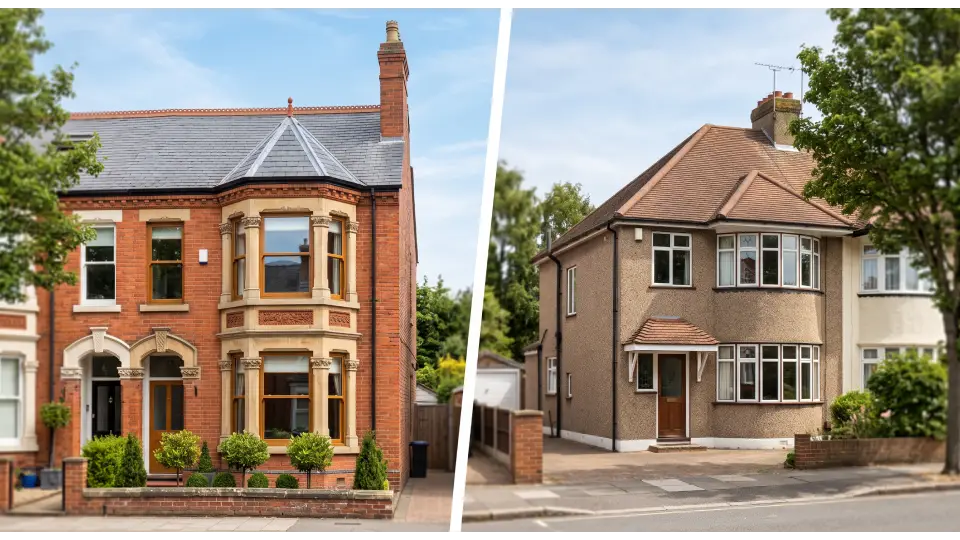

UK House Styles by Era: An Investor’s Guide from Georgian to the 1930s.
The UK's cheapest towns and postcodes to buy a house in 2026, ranked by average price, affordability ratio and rental yield - with drill-downs for England, Scotland, Wales and NI
Most guides to period property will tell you what a Georgian fanlight is. Very few will tell you what one costs to maintain, or why a beautiful pre-1919 house can be the hardest asset in your portfolio to let in 2030.
Around 20% of England's housing stock - roughly 5.15 million homes - was built before 1919, and about 35% before 1945. If you invest in UK residential property, you will end up buying period stock whether you set out to or not. The era it was built in determines its construction, its running costs, its energy rating, what you're allowed to do to it, and how much of your refurbishment budget disappears before you've improved anything a tenant will notice.
This guide covers how to identify each era, what each one actually costs to own, and how the eras compare side by side - including the retrofit problem that is going to reshape the economics of pre-1919 property over the next few years.
How to date a UK house
You can usually place a house within a couple of decades from the pavement. Look at the windows first, then the brickwork, then the roofline.
| Era | Unimproved EPC | Refurb cost (3-bed) | Heritage risk |
|---|---|---|---|
| Georgian1714–1830 | E–G | £60k–£120k+ | Highest |
| Victorian1837–1901 | D–E | £40k–£80k | Moderate |
| Edwardian1901–1918 | D–E | £35k–£70k | Lower |
| Interwar1918–1939 | D–E | £25k–£55k | Lowest |
Two quick tests. Window pane size tracks glass manufacturing: many small panes means early, fewer larger panes means later. Ceiling height peaked in the Victorian period and came down through the Edwardian era into the interwar years as plot efficiency mattered more than display.
House types, and how they changed by era
Era tells you how a house was built. Type tells you how it sits on its plot - and the two moved together.
A terraced house is one in a continuous row, sharing both side walls with its neighbours (an end-of-terrace shares only one). It's the defining British house type, and it exists because it was the most efficient way to build dense housing on expensive urban land. Georgian terraces were built for the wealthy around planned squares and crescents; Victorian terraces were built in vast numbers for working households near mills, docks and railways. Same type, opposite ends of the market.
Terraces carry two structural consequences worth knowing before you buy. Party walls mean any structural work - a loft conversion, a side return, underpinning - engages the Party Wall etc. Act 1996 and your neighbours' cooperation. And shared roof structures and drainage mean defects rarely stop at your boundary; a failing valley gutter or a shared drain run is a negotiation, not just a repair.
Back-to-backs - terraces sharing a rear wall as well as both sides, with no through ventilation - were built in industrial cities and largely cleared through the 20th century, though a number survive in Leeds. They're worth recognising because the lack of cross-ventilation creates chronic condensation problems that are expensive to solve.
Semi-detached houses became dominant between the wars. The interwar semi is the single most common house type in the UK, and its commercial appeal is straightforward: one party wall instead of two, side access to the rear, and a plot big enough to extend.
Detached houses and villas appear in every era but at much lower volume. Victorian and Edwardian villas - detached or semi-detached houses built for the professional middle classes - are often the best HMO and flat-conversion candidates in period stock, because the room sizes and floor areas are generous enough to carry a room count that works.
For investors the pattern is simple: terraces give you the cheapest entry and the highest density, semis give you the easiest extension route, and villas give you the conversion plays.
Georgian (1714–1830)
Proportion and symmetry, built to pattern books. Tall sash windows, high ceilings, fine joinery, often in terraces around a square or crescent. Bath, Bristol, Edinburgh's New Town, Bloomsbury.
What you're buying structurally. Solid brick or stone walls with no cavity. Lime mortar and lime plaster, which need to breathe - one of the most consequential facts about Georgian property, because sealing them with modern cement render or plastic paint traps moisture and causes the damp that then gets misdiagnosed as rising damp. Timber sash windows, usually single-glazed. Shallow foundations by modern standards. Often original or near-original drainage.
The investment reality. Georgian stock carries a genuine market premium and holds value well, particularly in cities where supply is fixed by geography and planning. But it is the most heavily protected era in the guide - a large share of surviving Georgian housing sits in conservation areas, and a meaningful proportion is listed. That constrains what you can change and lengthens every project.
Yields are typically the weakest of any era, because capital values are high relative to achievable rent. Where Georgian property genuinely works as an investment is in conversion plays - large townhouses split into flats or high-end HMOs in university and professional cities, where you're buying floor area cheaply per square foot and the room count carries the return. That's a planning and specification exercise, not a buy-and-let one.
Watch for: cement render trapping moisture in lime-built walls, sash window rot, roof and parapet repairs at height, and the standing cost of consent for anything you want to alter.
Victorian (1837–1901)
The backbone of British buy-to-let. Mass housebuilding for an industrialising population produced millions of terraced houses, and they remain the single most traded property type in the UK.
What you're buying structurally. Solid walls again - usually nine-inch brick, no cavity. Slate roofs. Suspended timber ground floors over a void, which must stay ventilated. A rear outrigger creating the characteristic L-shaped plan and side return. Original lath-and-plaster ceilings. High ceilings and deep skirtings.
The investment reality. This is where most portfolios are actually built, and for good reasons. Room sizes are generous, the stock is everywhere and liquid, and the layouts are unusually improvable. The side return infill and the loft conversion are two of the most reliable value-add moves in UK property, precisely because the original plan wastes space that a modern layout uses.
The offsetting problem is energy. Solid walls, single glazing where originals survive, and old heating systems combine to put unimproved Victorian stock firmly in the bottom EPC bands, and insulating a solid wall is expensive and intrusive in a way that filling a cavity is not. More on that below, because it is the defining issue for this era.
Watch for: damp from raised external ground levels and blocked subfloor air bricks, roof spread, rotten window and door lintels, undersized original drainage, and rewiring where previous work was done piecemeal.
Gothic Revival - a sub-style, not a category
Pointed arches, steep gables, polychrome brickwork, ecclesiastical detailing. Mostly churches, schools and civic buildings, but it shows up in housing too, especially in villas and larger detached homes.
For investors it matters mainly as a risk flag rather than an opportunity: strongly Gothic Revival buildings are disproportionately likely to be listed or locally designated, and the detailing that makes them distinctive - carved stone, decorative ironwork, stained glass, complex roof geometry - is expensive to repair correctly and hard to alter with consent. Beautiful buildings; treat any project appraisal with a wider contingency than the equivalent plain Victorian villa.
Edwardian (1901–1918)
A short era that produced some of the most liveable housing in the country. Land was cheaper on the expanding suburban fringe, and it shows.
What you're buying structurally. Wider frontages, shallower plans, more natural light, larger gardens. Construction is broadly Victorian - still predominantly solid wall - but the later part of the period starts to show early cavity construction, so it's worth checking rather than assuming. Better ventilation design, generally larger windows, and a plainer aesthetic that costs less to maintain than heavy Victorian ornament.
The investment reality. Often the sweet spot between period character and practicality. The wider plan is what makes the difference commercially: Edwardian houses convert to family lets easily, take extensions well, and typically offer three genuinely usable bedrooms where a comparable Victorian terrace offers two and a box room. They tend to command a rental premium over both Victorian terraces and interwar semis in the same street network, without the listing risk of Georgian.
Energy performance is marginally better than Victorian but still poor in unimproved form - same solid walls, same fundamental retrofit challenge.
Watch for: the cavity-or-not question at the survey stage, since it changes your insulation costs by an order of magnitude. Also FENSA or building regulations certification on any replaced windows, original roof coverings reaching end of life, and ventilation that has been compromised by later sealing.
Interwar (1918–1939)
The bay-fronted semi. Around four million homes went up between the wars, and for a lot of investors this is quietly the most efficient period stock in the country.
What you're buying structurally. This is the era construction changed. Cavity walls became standard, which is the single most important line in this guide for anyone worried about retrofit costs. Concrete foundations. Hipped tiled roofs. Generous plots with side access. Often original Crittall metal windows, which are thermally poor but restorable.
The investment reality. Interwar semis are the pragmatist's choice. They look like period property to a tenant, they have gardens and parking, and they sit in established suburbs with schools - so they let quickly to families and hold occupancy well. But structurally they behave like modern houses in the way that matters most to your budget: a cavity can be insulated for a fraction of the cost of insulating a solid wall, which puts an EPC C within realistic reach.
They also extend well. Side access and a decent plot make rear and side extensions and garage conversions straightforward, and permitted development often covers more than owners expect.
Watch for: wall tie failure in early cavity construction, which is a genuine structural issue in this era and shows up as horizontal cracking. Also cavities that were never filled or were filled badly, asbestos in mid-century materials, and original metal windows that are cold-bridging and prone to condensation.
The comparison: every era side by side
This is the view nobody else publishes in one place.
Scroll the table sideways to see all columns →
| Era | Wall construction | Typical unimproved EPC | Cost to reach EPC C | Typical refurb cost (3-bed) | Heritage risk | Value-add potential | Yield profile |
|---|---|---|---|---|---|---|---|
| Georgian1714–1830 | Solid brick/stone, lime mortar | E–G | Highest — often above the proposed cap | £60k–£120k+ | Highest — frequently listed and/or in a conservation area | Conversion to flats/HMO | Weakest — high capital value vs rent; works mainly as a conversion play |
| Victorian1837–1901 | Solid brick | D–E | High | £40k–£80k | Moderate — conservation areas common, listing less so | Side return, loft, HMO | Strong and flexible — the standard BTL and HMO stock |
| Edwardian1901–1918 | Mostly solid, some late cavity | D–E | High | £35k–£70k | Lower | Extension, loft | Solid — commands a family-let premium |
| Interwar1918–1939 | Cavity | D–E | Moderate | £25k–£55k | Lowest | Extension, garage conversion, loft | Most efficient — lowest retrofit drag, strong family demand |
Refurbishment ranges are indicative for a full renovation of a typical three-bedroom property and vary enormously by region, condition and specification. EPC bands reflect typical unimproved stock, not every property.
Read across the table and a pattern emerges: the further back you go, the more the building costs you and the less you are allowed to do about it. Character carries a real premium in capital value and in tenant demand. It is paid for in retrofit cost, maintenance intensity and planning friction.
The retrofit problem - and why it's about to get sharper
This is the part that matters most and gets the least coverage.
Where the rules stand now. Since 1 April 2020, you cannot let a property in England and Wales with an EPC below band E unless you have a registered exemption. The current cost cap on required improvements is £3,500 including VAT - spend that without reaching E and you can register an "all relevant improvements made" exemption, valid for five years, on the PRS Exemptions Register. Penalties reach £5,000 per property.
Where they are heading. The government has set out proposals to raise the standard, with landlords expected to comply from 1 October 2030, a £10,000 per-property cost cap, and a ten-year exemption where a property still falls short after that spend. The aim is for privately rented homes to reach EPC C or equivalent. The detailed policy design is still being finalised, so treat the date and the mechanism as firm intent rather than settled law - but treat it as coming.
Now put that next to the housing data.
Only 23% of pre-1919 homes are EPC band C or above. For post-1990 homes it is 86%.
Pre-1930 dwellings have a median SAP score of 59 - band E.
20% of pre-1919 dwellings need £15,000 or more to reach band C.
The proposed cap is £10,000. One in five pre-1919 homes needs more than £15,000. Those two numbers do not reconcile, and the gap falls almost entirely on Georgian and Victorian stock.
What that means in practice. A meaningful slice of pre-1919 rental property will not be brought to the proposed standard within the cap, and will depend on the exemption route to stay lettable. That is survivable - but an asset whose lettability rests on a registered exemption, renewable on a policy that can change, is carrying a risk that a 1930s semi with an unfilled cavity simply is not.
If you are buying pre-1919 stock to let, price the retrofit into the deal now rather than discovering it in 2030. Get a draft EPC before exchange and read the recommendations, not just the band.
The flip side is that this is a live source of below-market opportunity. Landlords selling because they don't want the retrofit are a real seller category, and solid-wall properties bought at a discount that reflects the work - where the numbers genuinely support the work - are exactly the kind of mispricing an informed buyer can act on.
Listed buildings and conservation areas: what actually restricts you
Heritage protection is the other era-linked cost, and it is widely misunderstood in both directions.
Listed buildings. Around 500,000 buildings in England are listed, and roughly 92% of those are Grade II - the least restrictive category, and the one nearly all listed housing falls into. Listing covers the whole building, inside and out, and often attached structures. Altering it without listed building consent is a criminal offence, not merely a planning breach. Expect consent to be needed for things owners routinely assume are minor: replacing windows, internal layout changes, even some redecoration of significant features.
Conservation areas. Far more likely to affect you than listing. There are 9,907 conservation areas in England, covering over 10% of properties. Protection is of the area's character rather than the individual building: controls typically bite on external alterations, windows, cladding, and trees, and permitted development rights are commonly restricted or removed by an Article 4 direction. Many investors discover the Article 4 position only after buying - check it before you offer, particularly for HMO conversion, where Article 4 frequently removes the permitted development right to convert to a small HMO.
The EPC point everyone gets wrong. There is no blanket EPC exemption for listed buildings or conservation areas. The exemption applies only insofar as complying with minimum energy performance requirements would unacceptably alter the building's character or appearance. If a building genuinely qualifies, it falls outside MEES too - but that is a determination to be made on the specific property, not an assumption to be made on the listing alone.
The practical route is to commission a draft EPC, look at what the recommended measures would actually involve, and ask the local authority's conservation officer whether those works would unacceptably alter the building. Assuming exemption because a property is listed is how landlords end up non-compliant.
So which era is the best investment?
Honest answer: the question is slightly wrong, and it's worth explaining why, because it protects you from a lot of bad content.
Era does not set your yield. Location does. Yield is rent divided by price, and both are driven overwhelmingly by where the property is. A Victorian terrace in a northern mill town and a Victorian terrace in a southern commuter town have almost nothing in common as investments. Any guide handing you a "typical yield by era" figure has invented it.
What era genuinely determines is the shape of the deal - how much capital the building absorbs before it earns anything, how much of your return is capital growth versus income, what you're permitted to change, and how exposed you are to tightening energy rules.
On that basis:
For income and simplicity - interwar. Cavity walls make the retrofit affordable, plots allow extension, and family demand is durable. The least glamorous and most efficient option.
For value-add - Victorian. The best combination of improvable layouts, liquidity and scale of stock. Side returns, lofts and HMO conversions are proven, repeatable plays.
For a family-let premium - Edwardian. Wider, lighter, better-proportioned, with less heritage friction than earlier stock.
For capital growth and conversion - Georgian. High entry cost, low yield, real scarcity value, and only sensible with a clear conversion strategy and a heritage-experienced team.
The best purchase is the one where you have priced the era's specific liabilities honestly - retrofit, maintenance intensity, consent risk - and the numbers still work. That's a survey and an appraisal question, not an architectural preference.
Frequently asked questions
How do I tell a Victorian house from an Edwardian one? Width and light. Victorian houses are typically narrow and deep with high ceilings and heavy decorative detail. Edwardian houses are wider and shallower, plainer, with bigger windows, more natural light and larger gardens. If it has mock-Tudor timbering and red brick with white-painted woodwork, it's almost certainly Edwardian.
Are period houses a good investment? They can be, but the economics differ from modern stock. You get character premium, established locations and strong tenant demand, against higher maintenance, worse energy performance and - in older eras - planning restrictions. The deciding factor is whether you priced the building's specific liabilities in before you bought.
What EPC rating do most period homes have? Unimproved pre-1919 stock typically sits in bands D to G, with a median of band E for pre-1930 dwellings. Only 23% of pre-1919 homes reach band C or above, compared with 86% of homes built after 1990.
Can I let a property with a low EPC rating? Not below band E, unless you have registered a valid exemption on the PRS Exemptions Register. The current cost cap on required improvements is £3,500 including VAT, and penalties reach £5,000 per property. The standard is proposed to rise, with compliance expected from 1 October 2030 and a £10,000 cap.
Why is it so expensive to insulate a Victorian house? No cavity. Pre-1919 walls are solid brick, so there is nothing to fill. Insulating means either internal wall insulation, which loses room space and disturbs original features, or external insulation, which changes the appearance and is often unacceptable in a conservation area. Both cost many times what filling a cavity costs, which is why interwar stock is so much cheaper to upgrade.
Are listed buildings exempt from EPC rules? Not automatically, and this is the most common misconception in period property. The exemption applies only where complying with minimum energy performance requirements would unacceptably alter the building's character or appearance. Get a draft EPC and ask the local conservation officer about the recommended measures rather than assuming.
What can't I do to a house in a conservation area? Typically external alterations, window replacement, cladding and tree work need consent, and permitted development rights are often restricted by an Article 4 direction. This matters commercially because Article 4 frequently removes the permitted development right to convert a house into a small HMO. Check the position before you offer.
Which era is cheapest to renovate? Interwar, by a clear margin. Cavity walls, concrete foundations, simpler roof structures and no heritage constraints in most cases. Georgian is the most expensive, both because of the building's construction and because of what you need consent for.
What is a back addition or outrigger? The narrow rear projection on a Victorian terrace that creates the L-shaped plan and the "side return" - the strip of yard alongside it. Infilling the side return is one of the most reliable ways to add value to a Victorian terrace, because it converts wasted external space into kitchen and living area.
Do period properties hold their value better? Period stock in desirable locations has historically shown resilience, helped by fixed supply - no one is building more Georgian terraces. But that's a location and scarcity effect as much as an age effect, and it doesn't offset a purchase made at the wrong price or a retrofit liability that wasn't priced in.
Finished reading?
- Take the next step.
If you are ready to take the next steps on your property journey
then our upcoming webinar is the perfect place to start.
About Progressive Property
Progressive Property has created more property millionaires and success stories in the UK than any other property investing education provider. Since 2007, Rob Moore, Mark Homer and their team of experts have built a welcoming, tight knit community to help people achieve freedom, choice and profit by investing in property.

Join Our Next Online Event!
Property Investing: Take Control Of Your Financial Future TODAY.
Register now